
Messaging That Moved Mountains: Lessons from the Gang of 19
October 16, 2026
5-minute read
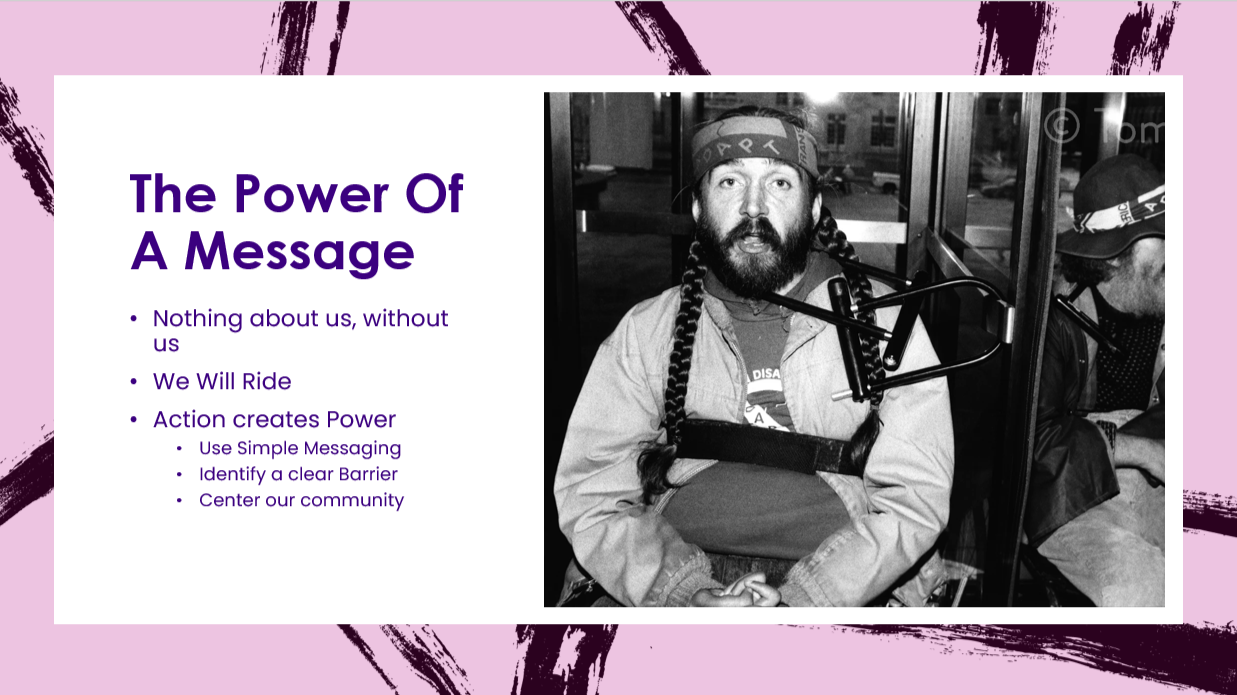
In 1978, nineteen disabled people surrounded two city buses in downtown Denver and refused to move.
The buses had no lifts. A whole category of people couldn’t ride public transit in their own city, and the city had decided that wasn’t a priority.
This fall I ran United Voices: Digital Advocacy for the Disability Vote, a workshop that teaches people in the disability community how to use social media to advocate for what matters to them and to encourage the disability community to get out and vote.
Brian Grewe, Executive Director of Atlantis Community, opened the first session by taking us back to that night in Denver.
The police came to make arrests, and couldn’t. The vehicles weren’t accessible. Neither were the jails. The city had built a system so inaccessible that it couldn’t even process the people protesting it.
So they arrested the caregivers instead.
I mean. Come on. You can’t write it better than that.
The protest held. The city eventually agreed to accessible transit. And that night grew into ADAPT, which became one of the most effective disability rights organizations in the country. Brian traced that line, and he’s got a PhD in cultural discourses of disability, so the man knows what he’s talking about. I took notes in my own workshop.
Nineteen people
The Gang of 19 were nineteen young people, and they didn’t all know each other. Some were strangers who got pulled in off the street that day, people who saw what was happening and decided to be part of it.
Nineteen people with no campaign plan, no budget, no communications department.
Nineteen people moved mountains across this country.
What they understood
The Gang of 19 did everything I spend the workshop teaching.
Vision, action, barrier. Every effective advocacy message has a vision, an action, and a barrier, and theirs were impossible to miss. The vision was disabled people moving freely through their own city, the barrier was a bus with no lift sitting right in front of them, and the action was making public transit accessible. They never had to explain any of it, because they were standing in front of the barrier while they said it.
Simple, memorable messaging. Their message was three words long. “We will ride.” There was no position paper and no list of demands with subsections, just one idea that a stranger could understand immediately and repeat to someone else that evening.
They knew exactly who needed to see it. They weren’t speaking to the general public in some vague sense, they were speaking to the city, the transit authority, and the press who would carry it beyond that intersection. When you know precisely who you’re trying to move, you can put yourself directly in their path, which is what they did.
Organizing. They organized, too, which is a different thing from showing up. Nineteen people who didn’t all know each other brought in more people as it went on, through phone trees and word of mouth and the kind of local relationships that take years to build.
Then other people carried it. The story left Denver, the tactics spread, and the work grew into ADAPT. The movement outlived the moment because it was built to be passed along.
Every one of those tools they used has a direct equivalent now, and most of us are holding all of them.
The panel discussion: thing two opposing advocates agreed on
On day two we had a panel with two advocates who, politically speaking, live on different planets. And they agreed on this: the second you say a politician’s name, half your audience becomes disengaged or defensive. Talk about the issue and more people listen.
One of our panelists, Judith Brown, has been doing get-out-the-vote work for years. She said, “I’m not focused on who people vote for. I just want them to vote.”
Which means the work is education. People need to know candidates’ opinions, values, and policies, and how those might affect their own lives and the lives of the disability community. There are real barriers in front of us, and we have to help each other make informed decisions before they get to the ballot box. Because real lives and real civil rights are at risk.
Today the ground is moving from underneath us
In September, a federal court stripped the community living protections out of the Section 504 rules. This is the rule that instructs federally funded programs to help disabled people live in their own homes instead of nursing homes. The underlying laws are still standing, what’s gone is the clear direction to states.
Access and equal opportunity. That’s what the Gang of 19 fought for and won. In the street. In 1978.
Everything right now is built to divide us, and our community is the one that can’t afford it. We are Deaf and Blind and autistic and wheelchair users and people whose disabilities you’d never guess, from every state and every politics, and the barriers in front of us do not check anyone’s registration before they get in the way.
So even when it’s hard, we should aim to be the unifiers. Even when the person next to us voted differently and we have to sit with that.
Because the alternative is going backwards. And we have fought too long, and too hard, and too recently, to let that happen.
What this means if you have something to say
You probably aren’t blocking a bus this week. But if you’re trying to get a message heard — for your organization, your community, or yourself — the same four questions apply:
Do you know your vision, your action, and your barrier? If you can’t say what you want, what’s in the way, and what you’re asking for, nobody reading it will be able to either.
Do you know exactly who needs to hear it? Not the general public. The specific people whose attention would change something.
Is your message simple enough to repeat? The test isn’t whether it sounds good, it’s whether someone can hear it once and say it to a friend that night.
Does it make people stop and pay attention? Nineteen people stopped a city at rush hour. Your post has about a second and a half to stop a scroll, which means it needs something true, something specific, or something only you can say.
And one more that belongs to this work specifically: can everyone actually receive it? A message with no captions doesn’t reach Deaf people. A graphic with no alt text doesn’t reach blind people. A video that plays automatically doesn’t give people with photosensitive epilepsy the chance to look away. These are things anyone doing this work should know, and most people never get taught.
The people who won that ground didn’t have budgets or platforms or a communications department. They had a clear message, they knew exactly who needed to hear it, and they had enough people willing to repeat it.
We’re holding more tools than they ever had, and the ground they won is shifting under us right now.
Nineteen people made a city listen with no platform at all. The least we can do is make sure ours are reaching everyone standing in the street with us.